Looking for some good news in these unprecedented times? There are already signs that the Covid-19 crisis will lead to a glorious flowering of great art.
In the autumn of 1938, while the world waited with baited breath as the European powers were on the brink of war, Salvador Dalí sat at his easel. Negotiations were being conducted by telephone and the surrealist incorporated melted telephones, exquisitely detailed portraits of Hitler and other Dalinian elements into paintings heavy with menace. They were perhaps the last great paintings he made. Just as Dalí turned the Munich Crisis into art, so artists are already turning Covid-19 into culture.
Despite the difficulties of Covid-19, could we be on the verge of a wave of serious culture? In fact, could the struggles ahead actually generate a flowering of satisfying art? Beyond the physical and economic realities of Covid-19, this challenge to society could stimulate creators in the way that past crises led creative figures to turn anxiety into art.
Across the world, concerts and performances have been postponed. St Patrick’s Day (17 March) was hit hard by restrictions against public gathering, not only in Ireland but also in countries with populations of Irish descent. With public houses closed, bands performed virtual gigs, audiences watching online. Glastonbury Festival, as other festivals, has been cancelled. Although performance may be restricted, creation is not. In fact, the enforced loss of touring could cause creators to go into the recording studio. Perhaps a songsmith such as Bruce Springsteen could be inspired to write songs about today’s enforced separation and future reuniting of families, set against the backdrop of economic uncertainty and social disruption. In the first wave of musical responses – dubbed pandemic pop – Mirai and Nikol Štíbrová produced a song about the crisis, while rappers have created a series of popular and informative songs, including one from Cardi B that entered the US and UK charts.
In the art world, Covid-19 has already had an impact. Art Basel Fair has been hit by travel restrictions and limitations on public gatherings. In response, many commercial galleries have set up virtual viewing rooms, allowing potential buyers to examine art online. Museums across the world have been closed.
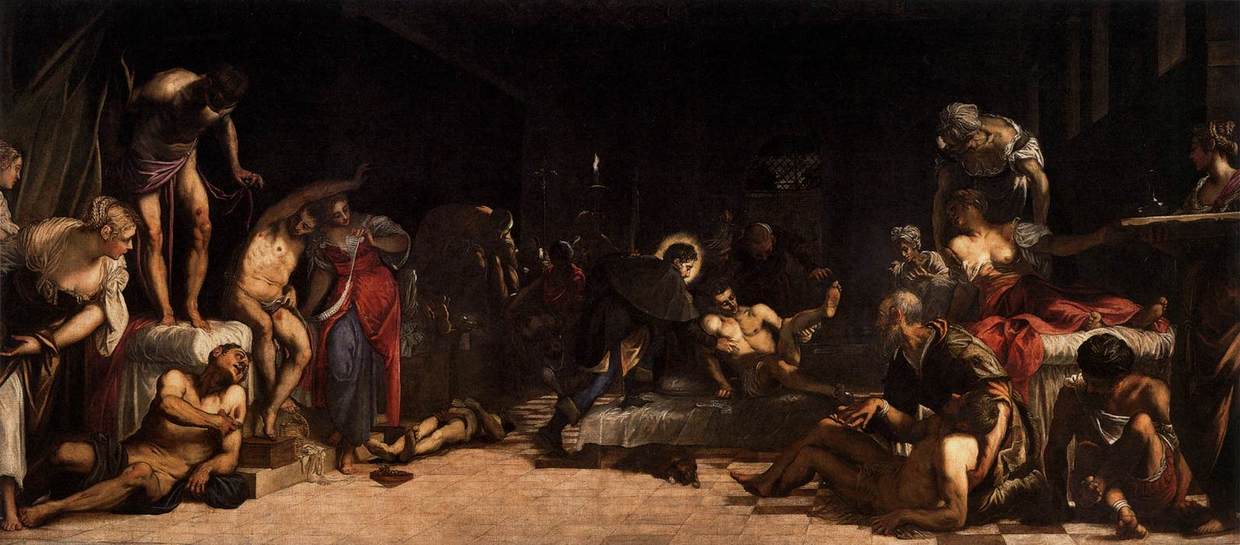
Venetian artist Tintoretto painted a series of exciting and dramatic Late Renaissance pictures based on the suffering of his age. Venice was periodically ravaged by plague. His paintings featuring St Mark (patron saint of Venice) and St Roche (patron saint of plague sufferers) were painted during times much more dangerous than ours. St Roch in the Hospital (1549) is a masterfully orchestrated composition, which movingly depicts the hope a visitation of the saint brings to the afflicted. Do we have painters today who can aspire to such heights? Narrative painting is out of fashion but this might be an opportunity for ambitious young artists eager to sweep away fashion for conceptualism.
Jacopo Tintoretto — St Roch in the Hospital (1549)
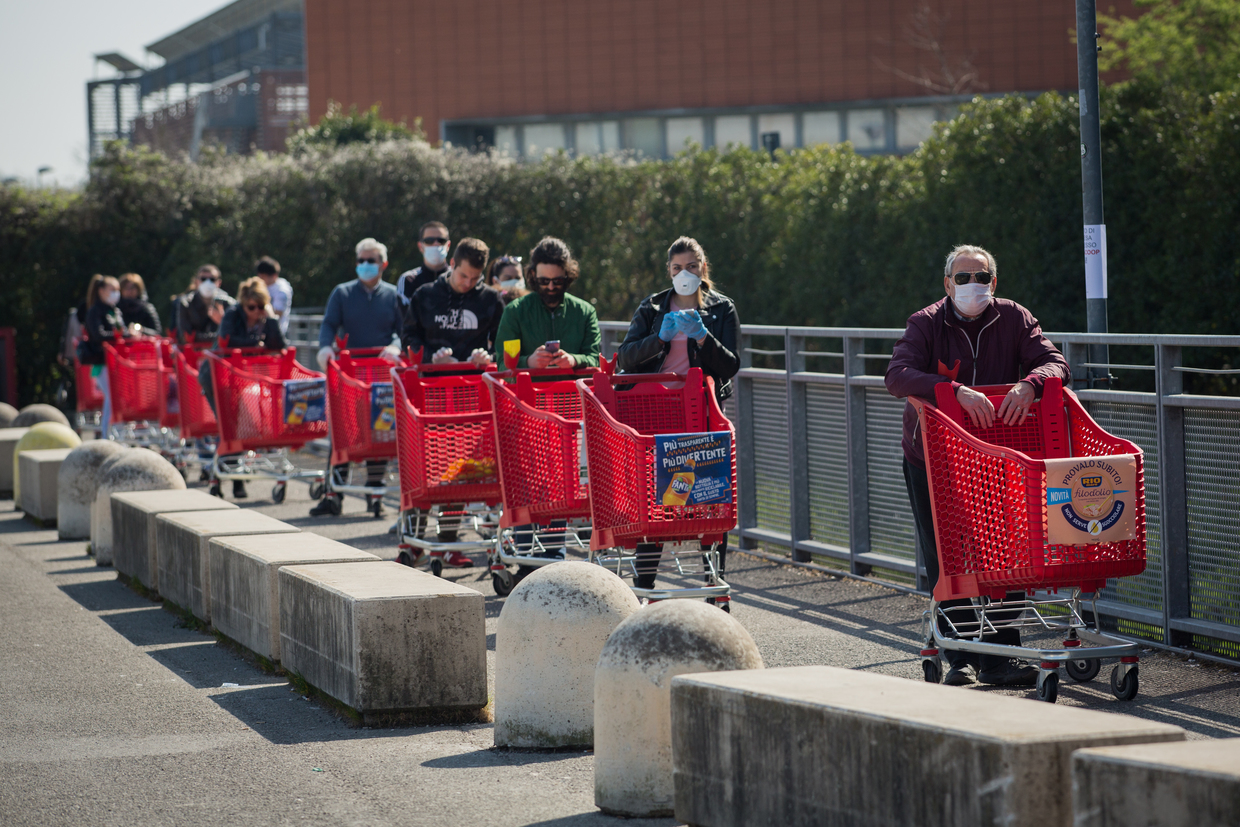
Documentary photographers have an opportunity to capture the strange desertion of high streets. If the extent of Covid-19 is longer than a few weeks, some businesses may close permanently. Traditional British public houses, already hit by the smoking ban and the choice of consumers to drink at home, may be decimated by orders prohibiting social gatherings. Already the closed restaurants and clubs have rendered familiar high streets strange. The peculiarities of shops setting up barriers between customers and counter staff, and the sight of people queuing up at regulation distance, are already visual markers of 2020.
Lines in front of a supermaket close to Bologna downtown on March 21, 2020 in Bologna, Italy.
Many television and movie production shoots have been halted. Film festivals and movie premieres have been called off. Although complete and near-complete movies will appear unchanged, projects in development may be modified or scrapped. This enforced shutdown has coincided with consumer rejection of political correctness. Could this provide an opportunity for studios and creators to drop their antagonistic stance by adopting less overtly political projects?
Pandemics have provided authors with material in the past. Stephen King’s novel The Stand (1978) was partly inspired by flu outbreaks and biological-weapon scares in the early 1970s. In it, a flu virus is accidentally released, leading to a fatal pandemic which reshapes society. The fictional disaster scenario allowed the novelist to examine the nature of good and evil, the way people gather into groups for protection and comfort and the way people’s characters are exposed by extraordinary circumstances. King has subsequently claimed that the book is the most popular with his readers and the one he is most often asked about.
In a more realistic vein, the situation of people during Covid-19 may be taken as a plot element by novelists such as Julian Barnes, Lionel Shriver, Paul Auster and others. There will also be plays and television dramas, not least crime thrillers featuring the unique quarantine situation. We will not get to see the best of Covid-19 in literature until the novels written soon are published in two or three years’ time.
For those creators sensitive and thoughtful enough, the restrictions of today could produce the great art of tomorrow. The shock of a serious societal problem will – for a time – dissolve those ‘first world problems’ that have preoccupied pampered creators in recent years. Perhaps our patience with ironic quasi-intellectual post-modern cultural games is at an end – about time, too.
Top board leaders of Texas' embattled power grid operator said Tuesday they will resign following outrage over more than 4 million customers losing electricity last week during a deadly winter...
Shares fell Wednesday in Asia as investors weighed the possibility that inflation might prompt central banks to adjust their ultra-low interest rate policies. Hong Kong led the decline, losing 2%...
She's guided the Senate through two impeachment trials, vexed Democrats and Republicans alike with parliamentary opinions and helped rescue Electoral College certificates from a pro-Trump mob ransacking the Capitol. She...