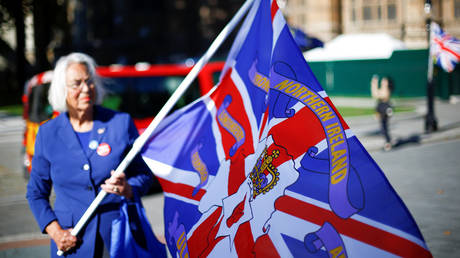
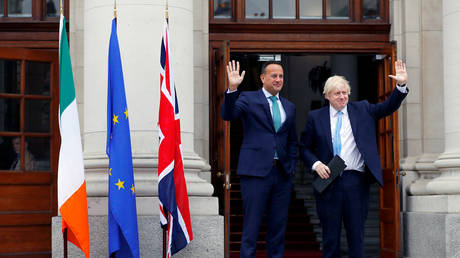
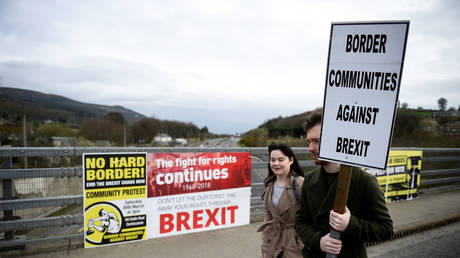
Boris Johnson has a “very good” plan for the Irish border, but prefers to keep the details veiled in “decent obscurity” for now. With days left to strike a deal, the PM might want to consider decently enlightening everyone.
The leaked UK proposals to Brussels for a “buffer zone” along both sides of the Irish border and customs checkpoints scattered at various locations five or 10 miles to the north and south are nothing short of insane — and have managed to unite the entire Irish political spectrum in outrage.
Here’s a map showing what a 10 mile buffer zone along *both* sides of the border would look like.
It’s all well and good for a Downing Street spokesperson to brush off the leak and reiterate an “absolute commitment” to avoid anything that involves “checks or controls at the border” proper, but that is a mere technicality.
In practice, customs checkpoints, whether they be two, five, or 10 miles from the crossing points — represent a hardening of the border which is illegal under the Good Friday Agreement — a binding international treaty — and the 2018 EU Withdrawal Act.
It is truly baffling to hear the British PM remain obstinately tight-lipped on his allegedly brilliant plans, while the livelihoods of so many hang in the balance. Asked if the 10-mile buffer zone would be part of his real plan, Johnson said that is “not what we are proposing at all,” but admitted checks somewhere would be a “reality.”
This idea rips up whole premise of negotiations, which were about how to avoid a border. This is a hard border with mass surveillance of locals crossing it. It will be seen as either a deliberate wrecking ploy from a govt that doesn’t want a deal, or a sign of hopeless delusion
Well, if there will be no checks at the border itself and no checks at the periphery of this imaginary buffer zone, where exactly will they be? Are we back to BoJo’s mystery technology solutions that have still yet to materialize? It should come as no surprise that a European Commission spokesperson said Brussels had “not received any proposals” from Johnson’s serially obfuscating government that meet the necessary requirements with respect to Ireland.
To add insult to injury, Johnson on Tuesday again quoted the late Ian Paisley, a sectarian bigot who in his time referred to Catholics as “vermin.” The Tory PM has repeatedly echoed Paisley’s words, saying the post-Brexit landscape could be one in which “the people are British, but the cattle are Irish.”
Am I the only Irish person living in the north of Ireland absolutely sick of hearing Johnson say the people here are British but the cattle can be Irish. He repeats it constantly. Does the #GFA say I have to change species to be recognised as Irish?
It’s well-established by now that BoJo cares little about the GFA — but it doesn’t take much in-depth study to understand that a fairly sizable chunk of the northern population consider themselves Irish, not British — and some consider themselves both. Indeed, the ability to identify as one, the other, or both, is foundational to the peace agreement.
The multitude of reasons why a hardening of the Irish border would be unworkable have been repeated to the Tories ad infinitum, chief among them the threat of rising sectarian tensions and violence that would be almost inevitable following the installation of border infrastructure. But it’s worth also repeating some of the logistical hurdles.
Let’s imagine a scenario where a buffer zone exists and checks are conducted in warehouses 10 miles out from the border. In a tweet thread responding to the leak, global trade expert Dr. Anna Jerzewska posed some interesting questions: Will traders, who are usually required to do import and export declarations, be forced to stop twice? Once in the northern portion of the buffer zone and once in the south? What about goods produced within the buffer zone itself, or from the farms that straddle the border? How are those goods tracked?
So many questions remain – do traders crossing the border need to stop twice? Normally you do export and then import declarations. How will that work? And if you’re coming from the rest of the UK do you also need to stop along the Irish Sea if standards and regulations differ? /7
How would checks away from the border work anyway in preventing smuggling? What’s to stop trucks full of goods just bypassing the checks and driving across the border? Is it meant to be an honesty system? I don’t get the basic logic of it
Then there’s the question of compliance. With no checks at the border proper, there would be nothing to stop trucks full of goods without tracking devices from driving illegally over the border post-Brexit. This is why the backstop measure, which can at least temporarily ensure regulatory alignment between north and south, is simply necessary to maintain an open, frictionless border. The risk of violence, loss of lives and livelihoods should trump the desires of hardline Brexiteers like the lounging and contemptible Jacob Rees-Mogg, who are unlikely to feel any ill-effects, no matter the outcome.
In a scenario where checks are conducted at the border itself, things become even more complicated. Some major commuter roads cross the border multiple times. In a video report explaining the logistics, journalist Oli Dugmore highlighted the road from Clones to Cavan, which, with its twists and turns, crosses the border four times. Should thousands of commuters expect to meet four checkpoints on their way to and from work? It’s not just roads either; there are literally houses divided by the border.
Boris Johnson has said that Irish border checks will be a “reality.”
There are nearly 300 crossing points along the border. Unless the British government is planning to barricade and spike the “unapproved” dirt roads, erect watchtowers in fields and return the rural borderlands to the militarized zone it was during the Troubles, there will be no way to control this zone absolutely.
If Johnson thinks sticking checkpoints “away from the border” eliminates the threat of violence, he is wrong. Nine people lost their lives when a customs point was blown up in 1972 — four miles from the border. “It is the same thing. It is dividing the country whether the border is there or six miles down the road,” a local told the Irish Times last month.
London is set to finally submit its last-ditch Brexit deal proposal to Brussels in the coming days after months of obfuscation and delay. This is your moment of truth, Boris. If you’ve got a better plan up your sleeve, let’s hear it.
Top board leaders of Texas' embattled power grid operator said Tuesday they will resign following outrage over more than 4 million customers losing electricity last week during a deadly winter...
Shares fell Wednesday in Asia as investors weighed the possibility that inflation might prompt central banks to adjust their ultra-low interest rate policies. Hong Kong led the decline, losing 2%...
She's guided the Senate through two impeachment trials, vexed Democrats and Republicans alike with parliamentary opinions and helped rescue Electoral College certificates from a pro-Trump mob ransacking the Capitol. She...