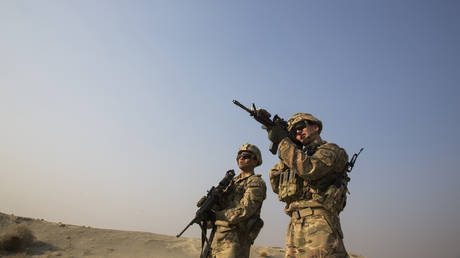
The Afghanistan War is the longest in American history and the US is still struggling to obtain a victory. Is it out of its depth, or should we expect better from an empire who has fought these types of wars for over a century?
On Monday, the US Department of Defense announced that an American service member was killed in action in Afghanistan. Over 12,000 US troops are currently deployed to the Islamic Republic.
Since 1990, US-led wars in the Middle East have killed some four million Muslims. The recently published Afghanistan papers, providing an insight into the longest war in US history, revealed how US officials continuously lied about the progress being made in Afghanistan, lacked a basic understanding of the country, were hiding evidence that the war was unwinnable, and had wasted as much as $1 trillion in the process.
Unfortunately, this phenomenon is nothing new. While most people accept the US has been interfering with Muslim populations quite heavily since World War II, the truth is that the United States has been fighting “forever wars” against Muslim populations for well over 100 years. (If you want to really go back into history, Thomas Jefferson was also fighting Muslims in the oft-forgotten Barbary Wars in the early 1800s).
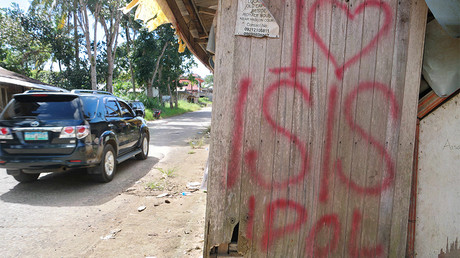
I won’t be too surprised if it doesn’t feature so heavily in the average Americans’ school curriculum but the US waged a war from 1899 to 1913 in the southernmost island of the Philippines. Known as the Moro War, it was the longest sustained military campaign in American history, until the war in Afghanistan surpassed it a few years ago. I might add that the US and the Philippine government are still embroiled in a battle with Islamist insurgents in the southern Philippines, which really takes the meaning of “forever war” to a whole new level.
Despite over a century passing since the US led a counterinsurgency war against the Islamic Moros, its similarities with the Afghanistan war are incredibly noteworthy, to say the least.
Even reading accounts of the terrain in which both conflicts were fought suggest they were equally as treacherous. As detailed in the memoir of Captain John Pershing, fighting the Moro Wars “entailed guerrilla warfare in a country unknown to us, with its swamps and rivers and its hills and mountains, every foot of which was familiar to the inhabitants and their insurrecto troops.”
While the US often boasts about fighting for freedom, I imagine most Americans may be wondering how it is that their freedom came to be located in the Philippines in the first place. Was it worth sending 75,000 American troops in just 1900 alone to the Philippines to fight and die, and was the operation even remotely successful?
More importantly seems to be the indication that the US military was not welcome in the Philippines, much as it is not welcomed by Afghanistan, or any other Muslim-majority nation which has to duel swords with the US Empire. After the US defeated the Spanish fleet in Manila Bay and annexed the Philippines under the 1898 Treaty of Paris, the Moro population were not even consulted. The US then sought to “pacify” them using brute force.
“I want no prisoners,” ordered General Jacob Smith on Samar Island during the war in 1902. “I wish you to kill and burn, the more you kill and burn the better you will please me.”
Fast forward over 100 years later, and I am struggling to see how US military doctrine has changed for the better. I am quickly reminded of a video that came to light in 2010 of then-General James Mattis saying that it was “a hell of a lot of fun to shoot” people in Afghanistan. Mattis was later rewarded for his heroism and bravery by being crowned Donald Trump’s secretary of defence for a short while.
As you can imagine, General Smith received his wish just as Mattis after him, with perhaps half a million locals dying as a result of the US invasion. At Bud Dajo, some 1,000 Moro separatists, including their families had fled to the crest of a volcano to escape the American invasion. Allegedly, American troops reached the top of the volcano and fired down into the crater until they killed 99 percent of the inhabitants. The colonizers then took the time and effort to pose for a photograph with the hundreds of dead bodies (no, seriously).
It is also worth noting that some 4,000 US soldiers lost their lives during this particular war. This closely mirrors the number of coalition deaths since 2001 in Afghanistan – and for good reason. To minimize US personnel deaths in the Philippines’ war, the US military deployed Filipinos led by US officers into battle. (Sound familiar?)
At one stage, Filipinos ended up doing almost all of the dying as US soldiers slowly left the battle theatre. In fact, the final year of conflict was the bloodiest year of the Moro war. This seems to be the trend in a number of US wars. This is certainly true with respect to Afghanistan, with the US military and its Afghan lackeys on the ground killing more civilians than the Taliban in recent times.
But what is all this senseless violence for? To put it simply, whether the Philippines, Iraq, Afghanistan or elsewhere, this rampage is all borne out of the belief that America’s subordinates are not capable of ruling themselves and will ultimately profit from American occupation. This was actually the firm thinking of US President Theodore Roosevelt, who saw it as the duty of the US to maintain the Philippines as a protectorate. If I remember correctly, this idea was famously (or infamously) termed the “White Man’s Burden” in a poem written by Rudyard Kipling, who sent it to Teddy prior to his decision to engage in the Philippine-American war. A 1902 Life Magazine cover even depicted an apparent waterboarding of a Filipino POW by US personnel (the supporters in the background seem to be watching with glee).
Not much has changed since then, or will ever change, I suppose. We can also expect this type of activity to continue for the unforeseeable future, given the geopolitical stakes at hand. In the case of the Philippines, it was recently reported that Chinese and Philippine foreign ministers have sealed an agreement for the two nations to pursue joint oil and gas exploration in the hotly contested South China Sea.
The South China Sea could contain anywhere between 125 billion barrels of crude oil and 500 trillion cubic feet of natural gas. The idea that a foreign adversary, especially one rising to prowess on the world stage such as China, could control the majority of these resources unchecked is a major blow to the US empire.
Whether it is lithium, or geostrategic chess moves in Afghanistan, or natural gas and oil in the South China Sea, Muslim populations will continue to suffer in a colonial terror campaign which has been unfolding for over 100 years.
Think your friends would be interested? Share this story!
Top board leaders of Texas' embattled power grid operator said Tuesday they will resign following outrage over more than 4 million customers losing electricity last week during a deadly winter...
Shares fell Wednesday in Asia as investors weighed the possibility that inflation might prompt central banks to adjust their ultra-low interest rate policies. Hong Kong led the decline, losing 2%...
She's guided the Senate through two impeachment trials, vexed Democrats and Republicans alike with parliamentary opinions and helped rescue Electoral College certificates from a pro-Trump mob ransacking the Capitol. She...